
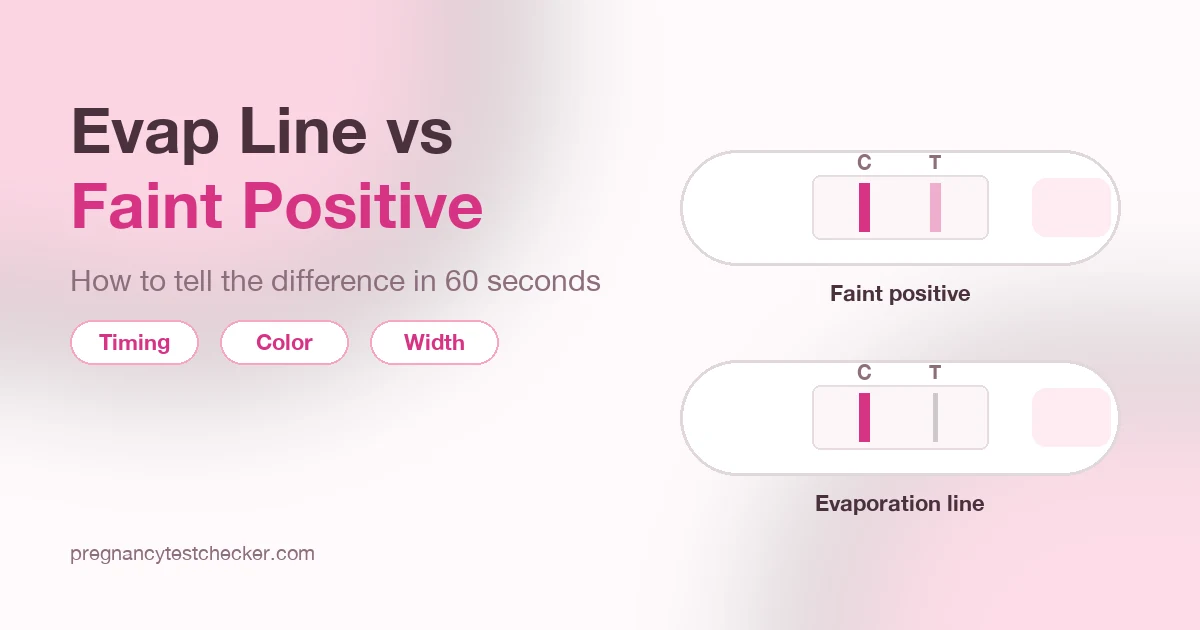
You took a pregnancy test, and there is something in the test window. Not a clear second line, but not nothing either. So which is it: an evap line or a faint positive?
Here is the short answer. A faint positive is a line with real color (pink or blue, matching the control line) that appears inside the read window, usually within 3 to 5 minutes. An evaporation line (evap line) is a colorless, gray, or shadowy streak that shows up after the read window, once the urine on the strip has started to dry.
The rest of this guide walks through the five differences in detail, shows you what each one looks like, and tells you exactly what to do next. If you want a second opinion on a photo of your test right now, our AI pregnancy test checker can analyze the line for you in seconds.
The 60-second check: Did the line appear within the read window? Does it have color? Is it about as wide as the control line? Three yeses means it is most likely a faint positive. A no on timing or color points to an evap line.
Evap Line vs Faint Positive at a Glance
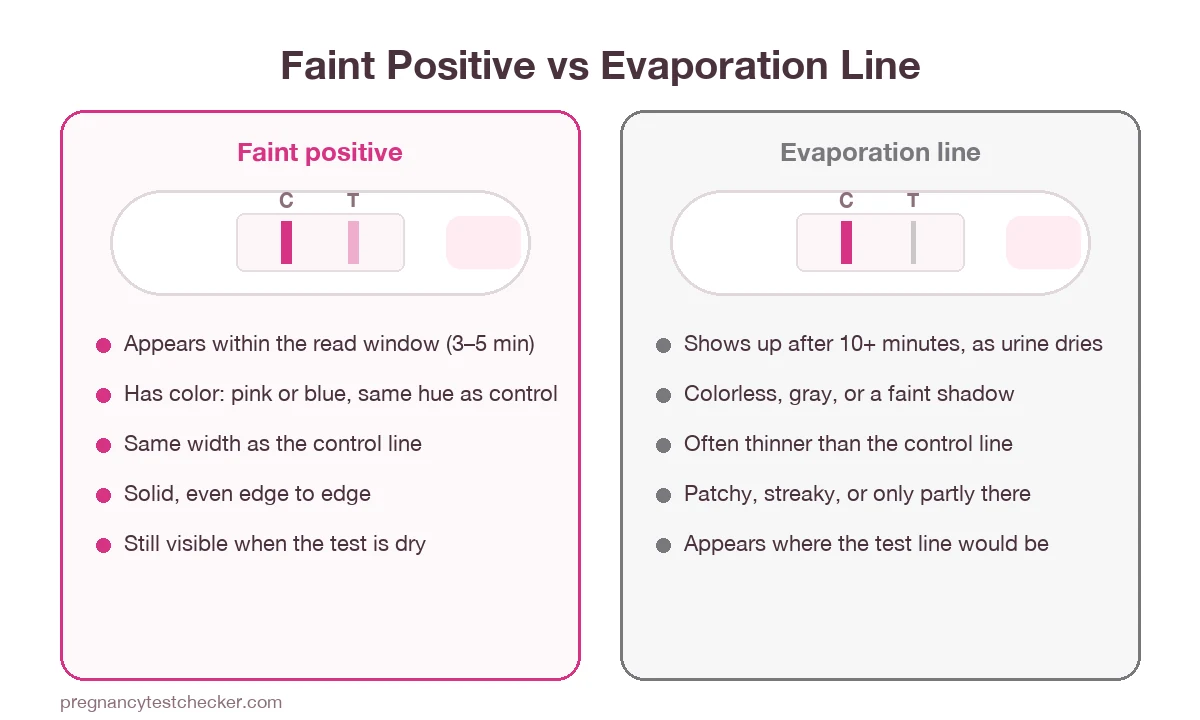
| Feature | Faint positive | Evaporation line |
|---|---|---|
| When it appears | Inside the read window (typically 3 to 5 minutes) | After the read window, often 10+ minutes, as the strip dries |
| Color | Pink or blue, the same hue as the control line, just lighter | Colorless, gray, silver, or a faint "shadow" |
| Width | Same width as the control line | Often thinner or uneven |
| Texture | Solid from top to bottom | Streaky, patchy, or broken |
| When dry | Still visible, sometimes slightly darker | Only visible once dry, or fades in and out |
| On retest in 48 hours | Usually darker | Not there, or still colorless |
| What it means | hCG detected, early pregnancy likely | Not a result. Treat the test as negative or invalid. |
Let AI Check Your Pregnancy Test
Just take a photo and get result

What Is an Evaporation Line?
An evaporation line is a mark left behind on the test strip as urine evaporates. Home pregnancy tests work by pulling urine across a strip that has a line of antibodies printed where the test line (T) sits. When hCG is present, dye binds there and a colored line forms. When hCG is absent, nothing binds, but the strip is still wet along that printed groove.
As the strip dries, the edge of the drying urine can leave a colorless or grayish residue exactly where a positive line would have been. That is the evap line. It is a physical artifact of drying, not a chemical reaction with hCG, which is why manufacturers such as Clearblue and First Response tell you not to read a test after the time limit.
What an evap line looks like
- No real color. Gray, silver, white-ish, or "a shadow of a line." It does not match the pink or blue of the control line.
- Thin or uneven. Often narrower than the control line, sometimes just an outline.
- Appears late. You looked at 3 minutes and saw nothing, came back at 15 minutes and found a line.
- Looks different as it dries. It may get more visible as the strip dries completely, which is the opposite of how a true positive behaves.
Evap line vs indent line
An indent line is a close cousin. It is the slight groove where the test antibodies are printed, and you can see it on almost any test, even an unused one, if you tilt it toward the light. Like an evap line it has no color. The difference is timing: an indent is visible from the start, while an evap line forms as the test dries. Neither is a positive.
What Is a Faint Positive?
A faint positive is a real test line that is lighter than the control line because the concentration of human chorionic gonadotropin (hCG) in your urine is still low. hCG is produced after implantation and roughly doubles every 48 to 72 hours in early pregnancy, according to the American Pregnancy Association. Test early enough and there is just enough hCG to trigger a light line.
The American College of Obstetricians and Gynecologists notes that home tests detect hCG in urine and that a line, even a faint one, read within the recommended time means hCG was detected. That is where the common saying "a line is a line" comes from.
What a faint positive looks like
- Has color. Light pink on a pink dye test, light blue on a blue dye test. The hue matches the control line.
- Same width as the control line. It may be pale, but it is not thinner.
- Appears inside the read window. Usually by the 3 to 5 minute mark.
- Stays put. It is still there when the test dries and usually looks the same or slightly darker.
If your line is so light that you are not sure it is there at all, read our guide to a very very faint line that is almost invisible, which covers how early testing and test sensitivity affect what you see.
The 5 Differences Between an Evap Line and a Faint Positive
1. Timing: when the line appeared
This is the single most reliable clue. Every test comes with a read window printed in the instructions, usually "read at 3 minutes, do not read after 10 minutes" or similar. A line that is present inside that window counts. A line that only shows up afterwards does not, no matter how convincing it looks.
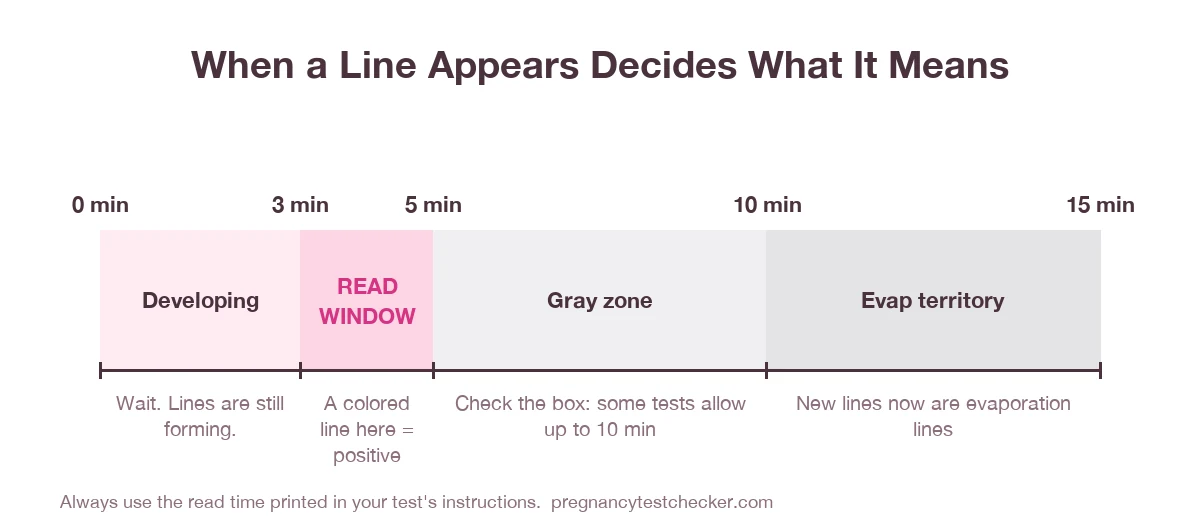
Set a timer when you take the test. Look at the result at the time stated, decide, and then put the test away. Pulling a test out of the bin an hour later is the number one way people end up asking "evap line or faint positive?"
2. Color: pink/blue vs gray
A true positive is made of dye. Dye has color. If the second line is pink on a pink dye test or blue on a blue dye test, it is almost certainly a positive, however light. If it is gray, silver, or looks like a shadow with no tint at all, it is most likely an evaporation or indent line.
Lighting matters here. Check the test under natural daylight or a white light, not a warm bulb that tints everything. If you are using a photo, our pregnancy test inverter flips the colors so that even a light pink line stands out as a bright teal line, while a colorless evap line stays dull.
3. Width: same as the control line vs thinner
Dye binds along the full width of the printed antibody stripe, so a real test line is the same width as the control line. Evap lines tend to be thinner because they form at the drying edge of the urine, not across the entire stripe. A hairline, or a line that is wide at one end and narrow at the other, points to evaporation.
4. Texture: solid vs streaky
Look closely. A faint positive is uniform from top to bottom, even when pale. An evaporation line is often patchy, streaky, or broken, like a smudge rather than a printed line. Dye runs, where excess dye drags across the window, can also create streaks, but those usually have a smeared, irregular shape instead of a crisp vertical line.
5. What happens when you retest
This is the tiebreaker. If the first line was a true positive, hCG will have roughly doubled 48 hours later and the next line should be noticeably darker. If it was an evap line, the next test (read within the window) will be blank. We cover the ideal timing below.
Let AI Check Your Pregnancy Test
Just take a photo and get result
Is It an Evap Line or a Faint Positive? A Quick Decision Flow
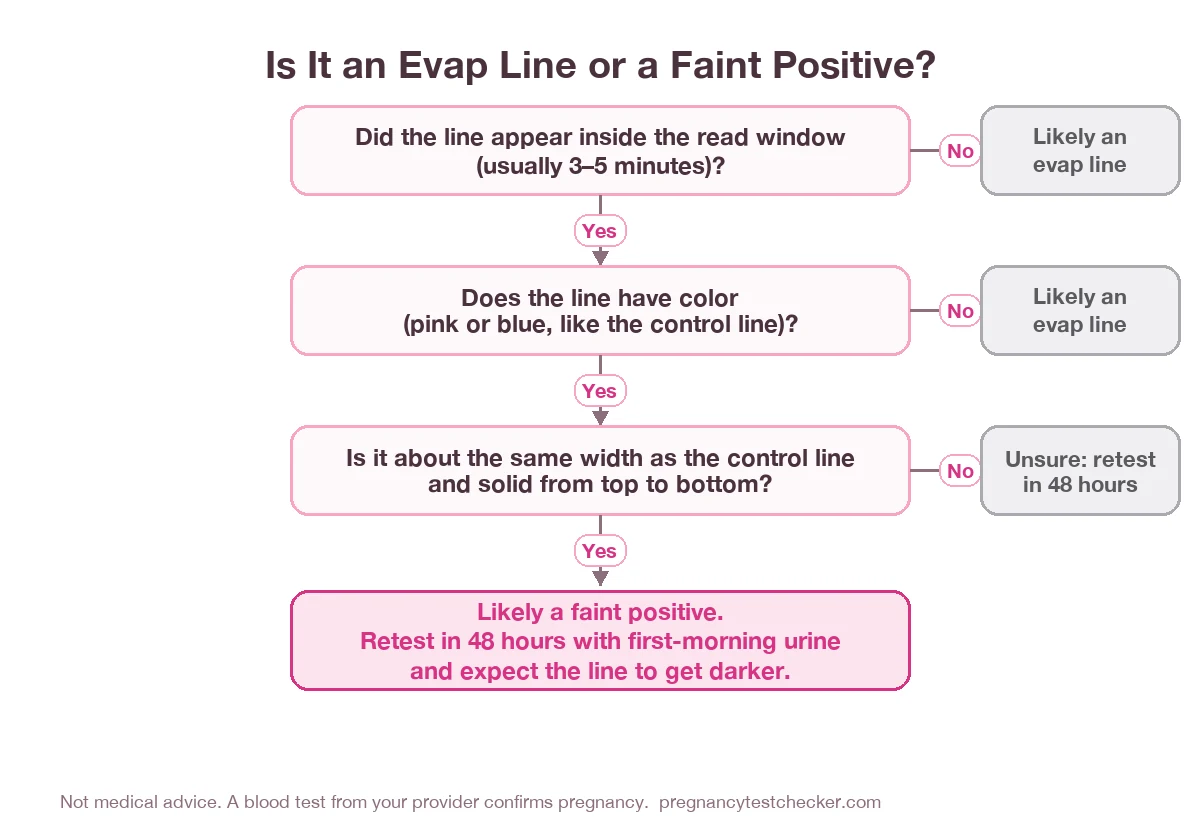
- Did it appear inside the read window? No: evap line. Yes: keep going.
- Does it have color that matches the control line? No: evap or indent line. Yes: keep going.
- Is it about the same width, and solid top to bottom? No: unsure, retest. Yes: likely a faint positive.
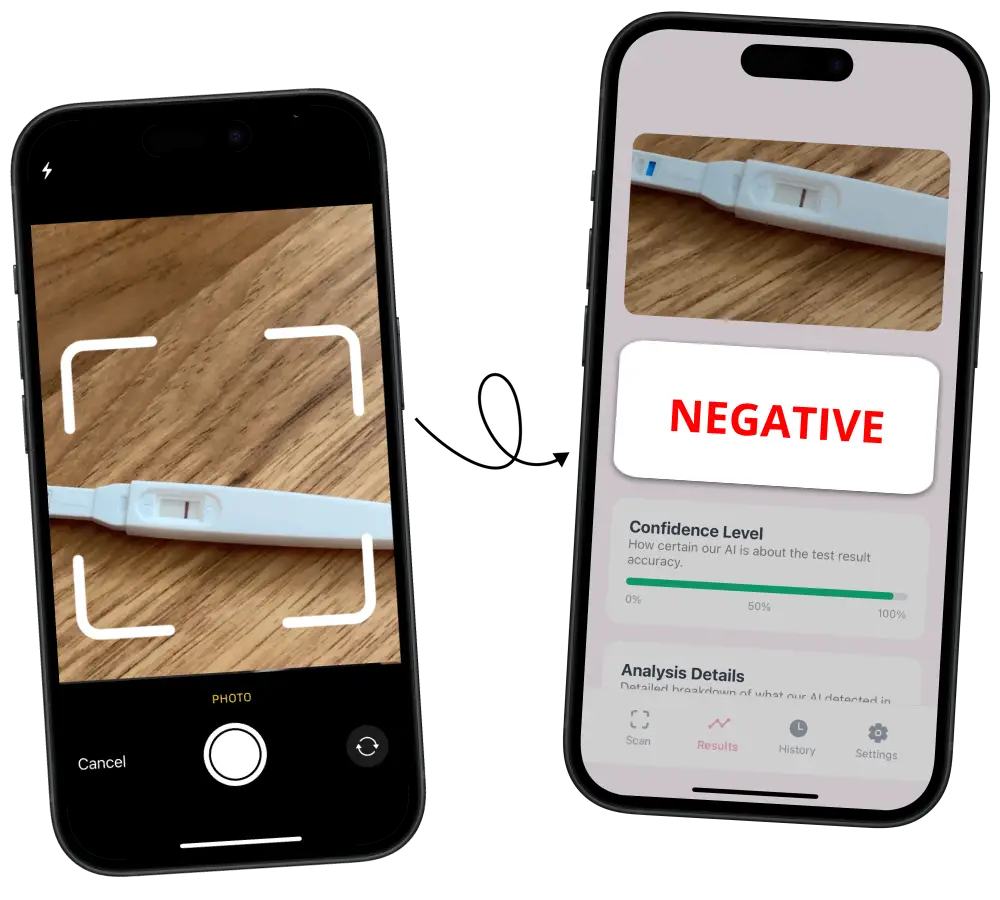
You can also skip the squinting. Take a photo in good light and let our AI pregnancy test checker analyze it. The app looks at line color, intensity, and position rather than just whether "something" is there, which is exactly the judgment call that separates an evap line from a faint positive. Read how pregnancy test scanner apps work if you are curious about the method.
Why Evap Lines Happen (and How to Avoid Them)
Reading the test too late
The most common cause by far. Tests are designed to be read at a specific time because the manufacturer has validated the result only for that window. After that, the strip keeps drying and the chemistry keeps changing. Set a timer and stick to it.
Blue dye tests
Many people report more ambiguous lines on blue dye tests than on pink dye tests. Part of the reason is simple contrast: a gray evap line is easy to mistake for a light blue positive, but hard to mistake for a pink one. If you keep getting unclear results on blue dye tests, switch to a pink dye brand. Our Walgreens Early Result faint line guide covers one popular pink dye option.
Dilute urine and testing too early
Very dilute urine, or testing before implantation has had time to produce measurable hCG, gives you a negative test with a wet strip and nothing to show for it. That is exactly the setup for an evaporation line once the strip dries. Testing with first-morning urine and waiting until at least the day of your expected period reduces both false negatives and evap-line confusion. If you are unsure when to test, use our when can I take a pregnancy test calculator.
Taking the test apart
Pulling the strip out of a cassette test to get a closer look exposes the strip to air and light and speeds up drying. It also voids the manufacturer's instructions. Lines seen on a disassembled strip are not reliable in either direction.
What to Do After a Faint Line
If you think it is a faint positive
- Wait 48 hours and retest with first-morning urine. hCG should have roughly doubled, so expect a darker line.
- Consider a digital test. It prints "Pregnant" or "Not pregnant" and removes the line interpretation entirely. Digital tests are often a little less sensitive than the best early-result strip tests, so a digital negative a day after a faint strip positive is not unusual.
- Book a confirmation. A quantitative blood test at your provider's office measures the exact hCG level and is the definitive answer. See where you can go to see if you are pregnant.
If you think it is an evap line
- Treat the test as negative. An evap line is not a result.
- Retest in 2 to 3 days if your period still has not arrived, and this time read the test at exactly the stated time.
- Use a pink dye or digital test for the retest to reduce ambiguity.
If you are still not sure
You are not alone. Faint lines are one of the most searched pregnancy test topics for a reason. Take a clear photo inside the read window, in daylight, with the test flat and the camera directly above it, and keep it. Comparing the photo of today's test against a photo from two days later is far more reliable than relying on memory. The Pregnancy Test Checker AI app saves each scan with a timestamp so you can track progression.
Faint Positive but Not Pregnant: Other Causes of a Light Colored Line
A colored line inside the read window means hCG was detected. Most of the time that means early pregnancy, but a few other situations can produce a faint colored line:
- Chemical pregnancy. A very early pregnancy loss, often before or around the time of a missed period. The line is faint, does not darken, and a period follows. The American Pregnancy Association estimates these account for a large share of early losses.
- Recent pregnancy, miscarriage, or abortion. hCG can stay detectable for days to weeks afterward.
- Fertility medications containing hCG (trigger shots). Testing too soon after a trigger shot can show the injected hormone rather than a pregnancy.
- Rare medical causes. Certain tumors and conditions produce hCG. The Mayo Clinic lists these as uncommon causes of false positives.
If your faint positive does not darken over several days, or you have pain or heavy bleeding, contact your healthcare provider.
Frequently Asked Questions: Evap Line vs Faint Positive
Can an evap line be pink?
Usually not. A true evaporation line is colorless, gray, or a faint shadow left by dried urine. A line that appears after the read window can occasionally pick up a slight tint from leftover dye, but it will not match the pink or blue of the control line. A line with real color that appeared inside the read window is far more likely to be a faint positive.
Can an evap line appear within 5 minutes?
It is uncommon. Evaporation lines form as urine dries across the strip, which takes longer than the 3 to 5 minute read window on most tests. A colorless line inside the window is more often an indent line, which is visible when light hits the printed groove at an angle. Check for color and whether the line is still there when the test is dry.
Does a faint positive mean I am pregnant?
A colored line inside the read window means the test detected hCG. Most faint positives are early pregnancies with low hCG. Less often, a faint line reflects a chemical pregnancy, a recent pregnancy loss, or fertility medication. Retest in 48 hours and expect the line to darken, and confirm with your provider.
Why does the line disappear when the test dries?
If a line fades or vanishes as the test dries, it was most likely moisture or a dye run rather than a true positive. A real hCG line is dye bound to the strip and does not disappear when dry. The opposite, a line that only appears after drying, is the classic evaporation line.
Are blue dye tests more likely to show evap lines?
Many users report more ambiguous lines on blue dye tests, because a gray evaporation line is harder to distinguish from a light blue positive than from a pink one. If you keep getting unclear results on blue dye tests, retest with a pink dye or digital test.
Should I retest after an evap line?
Yes, if your period has not arrived. Wait 48 hours, use first-morning urine, and read the test only inside the window printed in the instructions. If the next test shows a colored line inside the window, treat it as positive. If it stays blank and your period is more than a week late, contact your provider.
What is the difference between an evap line and an indent line?
An evap line appears after the read window as urine dries. An indent line is the physical groove where the test antibodies are printed and can be seen on any test, even an unused one, when tilted toward the light. Both are colorless, and neither is a positive result.
Can a faint line get lighter and still be a positive?
A line that gets lighter on retests after a true positive can indicate a chemical pregnancy or very early loss. It can also happen if the second test was taken with much more dilute urine or a less sensitive brand. Repeat with first-morning urine and the same brand before drawing conclusions, and talk to your provider if lines keep fading.
Let AI Check Your Pregnancy Test
Just take a photo and get result
Bottom Line: Evap Line vs Faint Positive
An evap line is colorless, often thin or streaky, and shows up after the read window as the test dries. A faint positive has real pink or blue color, matches the control line's width, and appears inside the read window. Timing and color settle most cases on their own.
When they do not, the fix is the same every time: retest in 48 hours with first-morning urine, read it at the stated time, and expect a true positive to get darker. For a definitive answer, a blood test from your healthcare provider measures hCG directly.
And if you would rather not squint at a strip under the bathroom light, snap a photo and let the Pregnancy Test Checker AI do the reading for you.