
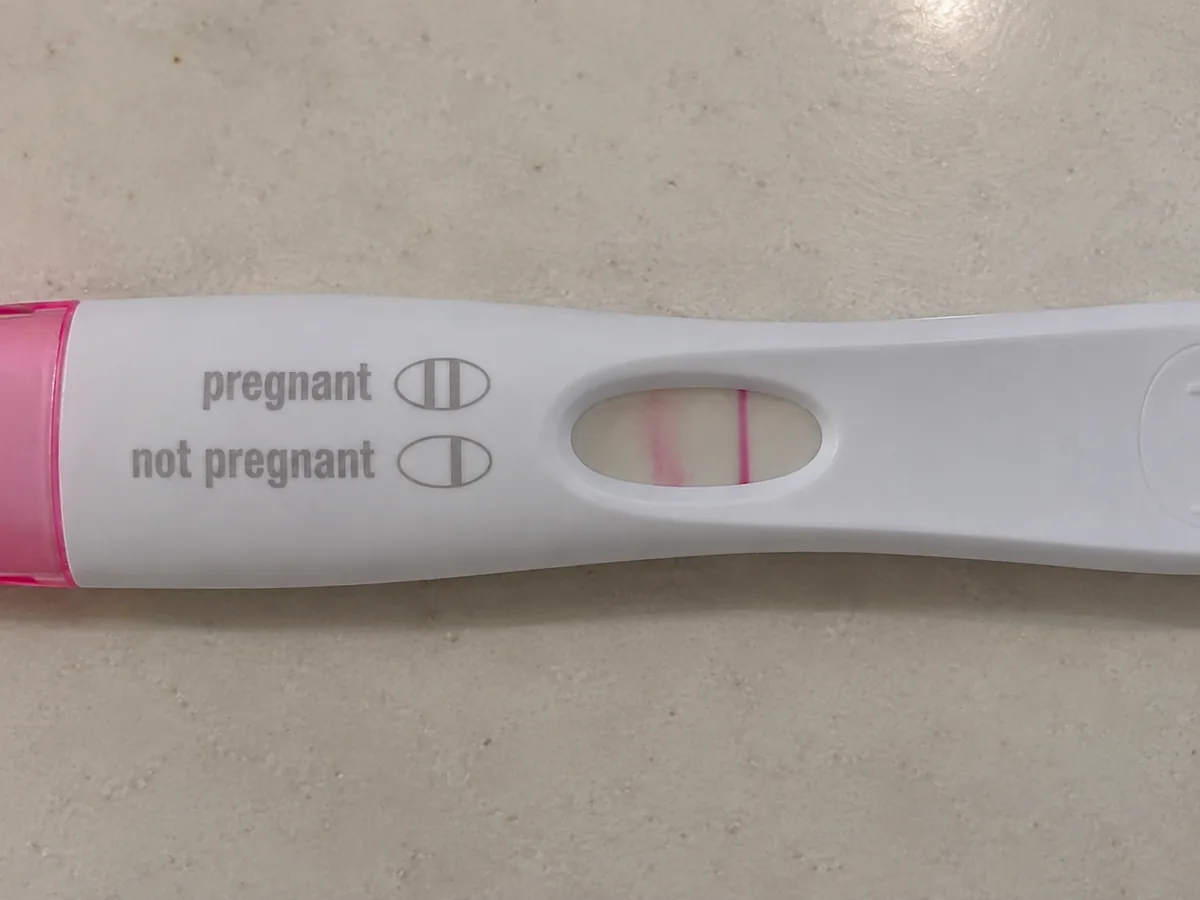
You dipped the test, waited, and instead of one or two neat lines the result window turned into a pink smear, a streak, or a blotch that looks almost, but not quite, like a line. That is a dye run on a pregnancy test, and it is one of the most common reasons people end up staring at a test wondering "is that positive?"
Here is the short version. A dye run is excess dye moving across, or getting stuck in, the result window. It is not a reaction to hCG, so it is not a positive. A brief wash of color in the first minute is normal and should clear on its own. A smear that is still there at the read time means the test is invalid and you need to take another one.
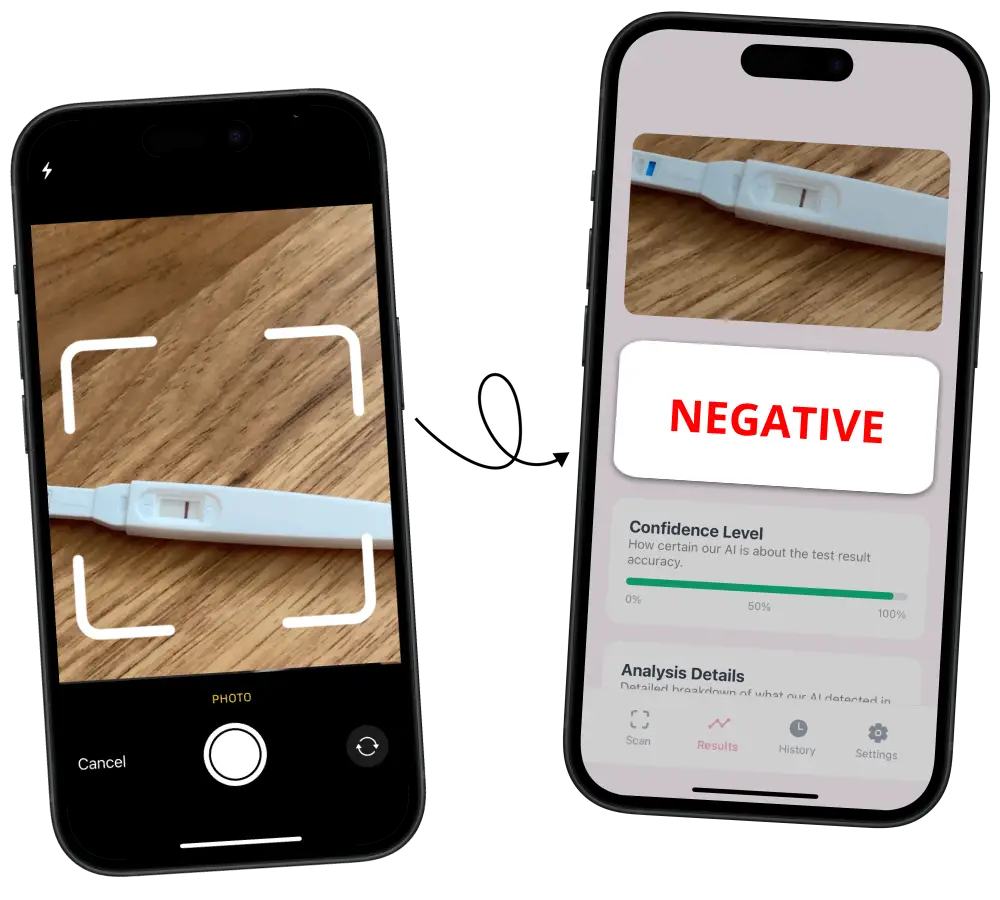
Below you will find what a dye run looks like, why it happens, how to tell it apart from a faint positive or an evaporation line, and what to do next. If you have a photo of your test, our AI pregnancy test checker can tell you in seconds whether what you are looking at is a real line.
Quick rule: A real positive is a crisp, straight, vertical line exactly at the T mark, the same width as the control line, that stays after the window clears. Anything blotchy, angled, trailing, or spread across the window is dye, not a result.
What Is a Dye Run on a Pregnancy Test?
Every home pregnancy test contains dye particles that are released when urine hits the absorbent tip. The sample carries that dye along the strip. At the control line (C), dye binds no matter what, which is how you know the test worked. At the test line (T), dye binds only if hCG is present.
Dye that does not bind anywhere is supposed to keep flowing past the result window into the far end of the strip, leaving the window clean. A dye run happens when that excess dye lingers in the window instead. You see it as a pink (or blue) wash, streak, or blotch.
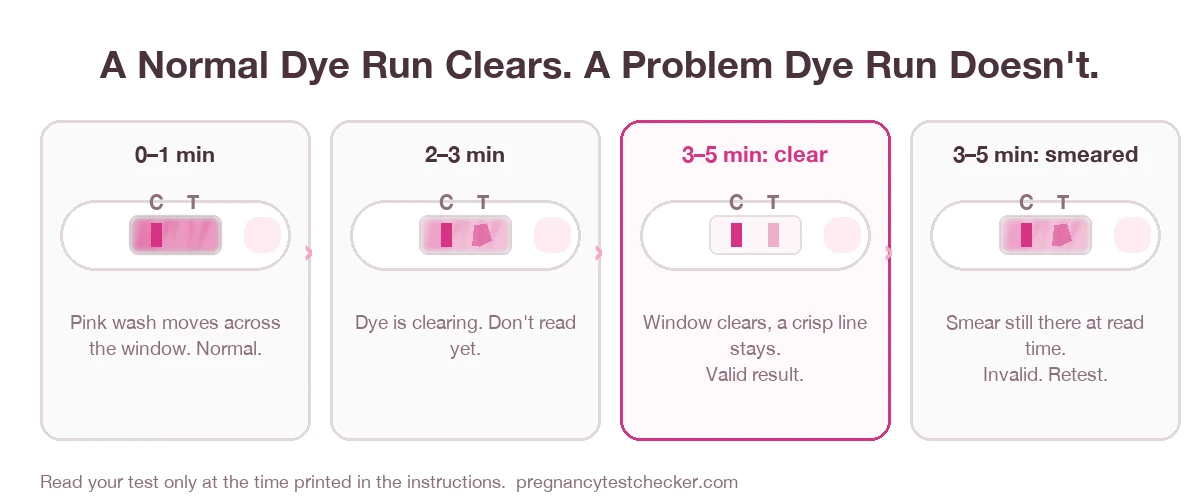
Normal dye run vs problem dye run
Almost every test has a moment, around 30 to 90 seconds in, when the whole window looks pink as the wave of dye passes through. That is normal and it is why instructions tell you to wait. A problem dye run is when the color never clears, or clears unevenly and leaves blotches behind at the time you are supposed to read the result.
What a Dye Run Looks Like
People describe dye runs in a lot of different ways, which is part of why they are confusing. These are the most common forms:
- Pink or blue wash. The entire result window is tinted and the lines are hard to make out.
- Streaks. Several thin vertical or diagonal lines of color that do not line up with the C or T marks.
- Blotch near the test line. A ragged patch of color sitting roughly where a positive line would be. This is the one most often mistaken for a faint positive.
- Trailing line. A line that starts crisp at the top and smears or fades into a tail at the bottom.
- Blurred control line. The control line itself looks fuzzy or bleeds sideways. A blurred or missing control line makes the test invalid on its own.
- Dye stuck at the edge. A band of color against one edge of the window that never moves.
The common thread is that none of these look like a line in the strict sense: straight, vertical, even in width, with clean edges, and positioned exactly at the T mark.
Let AI Check Your Pregnancy Test
Just take a photo and get result

Dye Run vs Faint Positive vs Evap Line
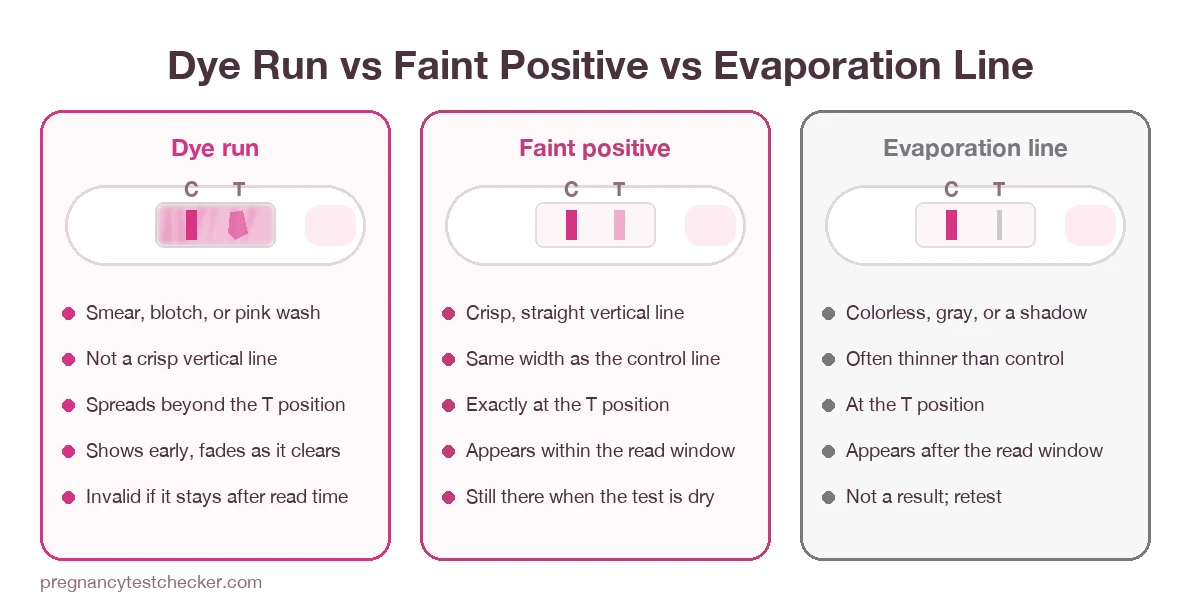
These three get mixed up constantly, and the fix for each is different, so it is worth being precise.
| Feature | Dye run | Faint positive | Evaporation line |
|---|---|---|---|
| Shape | Smear, blotch, streak, or wash | Crisp, straight, vertical line | Thin line or shadow |
| Color | Pink or blue, often uneven | Pink or blue, matches control | Colorless or gray |
| Position | Anywhere in the window | Exactly at the T mark | At the T mark |
| Width | Irregular | Same as the control line | Usually thinner |
| When it appears | First 1 to 2 minutes | Inside the read window | After the read window |
| What happens next | Often clears or fades | Stays, darkens on retest | Stays or gets more visible when dry |
| Verdict | Invalid if still there at read time | Positive | Not a result |
Dye run vs faint positive
The giveaway is geometry. A faint positive can be very light, but it is still a proper line: thin, straight, top-to-bottom, with edges parallel to the control line. A dye run is irregular. It may be wider at one end, angled, patchy, or sitting slightly off the T position. If you have to tilt the test and squint to decide whether the blob is a line, it is probably not one. Our guide to a very faint line that is almost invisible covers what a genuine light line looks like.
A useful trick: run the photo through our pregnancy test inverter. A true line inverts to a crisp bright stripe. A dye run inverts to a blurry cloud.
Dye run vs evaporation line
These are almost opposites. A dye run has color and shows up early, while the strip is wet. An evaporation line has no color and shows up late, after the read window, as the strip dries. If your "line" is gray and appeared at the 20 minute mark, read evap line vs faint positive instead.
Why Dye Runs Happen
Too much urine
This is the number one cause. Holding a midstream test in the stream for 15 seconds when the box says 5, or leaving a dip strip in the cup for a minute, floods the strip. Too much liquid pushes dye through too fast and unevenly, and some of it stalls in the window. More urine does not make the test more sensitive. It makes it less reliable.
Reading too early
At 60 seconds, almost every test looks like a dye run because the dye wave is passing through. If you photograph or judge the test before the read time, you are looking at a test that has not finished. Set a timer and look only when it goes off.
Holding the test tip-up or upside down
After dipping, the test should lie flat with the result window facing up. Holding it tip-up lets the sample flow backward, and placing it window-down on a wet counter can wick extra liquid in. Both cause flooding.
Using the dropper wrong on cassette tests
Cassette tests with a separate sample well need an exact number of drops, placed in the well only. Extra drops, or drops landing on the result window, cause a dye run almost every time.
Expired, damaged, or cheap tests
Dye and antibodies degrade with age, heat, and humidity. A test left in a hot car or stored in a steamy bathroom for a year is more likely to shed dye unevenly. Very low-cost strips also vary in quality from batch to batch. The FDA recommends checking the expiry date and storing tests as the label directs.
Blue dye tests
Users widely report that blue dye tests run more than pink dye tests, and that blue dye runs are harder to tell from faint positives. If you keep getting smeared blue windows, switching to a pink dye brand for the retest is a reasonable move. Our Walgreens Early Result guide covers one widely available pink dye option.
Let AI Check Your Pregnancy Test
Just take a photo and get result
Is a Test With a Dye Run Still Valid?
It depends on what the window looks like at the read time printed in the instructions, usually 3 to 5 minutes. Use this checklist:
- Window cleared, control line crisp, no second line. Valid negative.
- Window cleared, control line crisp, a crisp second line at T. Valid positive, even if the line is faint.
- Window still smeared or washed with color. Invalid. You cannot read lines through a dye run. Retest.
- Control line missing, blurred, or bleeding. Invalid regardless of what else you see.
- A blotch at T with ragged edges, but the rest of the window is clear. Treat as unclear. Retest in 48 hours rather than calling it positive.
Manufacturers such as Clearblue and First Response state that a result without a clear control line, or read outside the stated time, should not be trusted.
What to Do After a Dye Run
- Do not try to "read through" the smear. Guessing at lines inside a flooded window leads to both false hope and false reassurance.
- Retest with a fresh test. If you have another test in the box, you can retest the same day with a different sample. If you only have one, retest in 48 hours with first-morning urine.
- Follow the timing exactly. Count the seconds in the stream or cup, lay the test flat, set a timer for the read time, and judge only when it goes off.
- Photograph the retest at read time in daylight, flat, camera directly above. A photo taken at the right moment is far easier to judge than a test fished out of the bin an hour later. The Pregnancy Test Checker AI app timestamps each scan so you can compare tests across days.
- If dye runs keep happening with one brand, switch brands. Some strips are simply more prone to it.
- Still unsure after two tests? A blood test from your provider measures hCG directly and ends the guessing. See where you can go to see if you are pregnant.
Not sure if it is even the right day to be testing? Our when can I take a pregnancy test calculator tells you when a test is likely to be accurate for your cycle.
How to Prevent a Dye Run Next Time
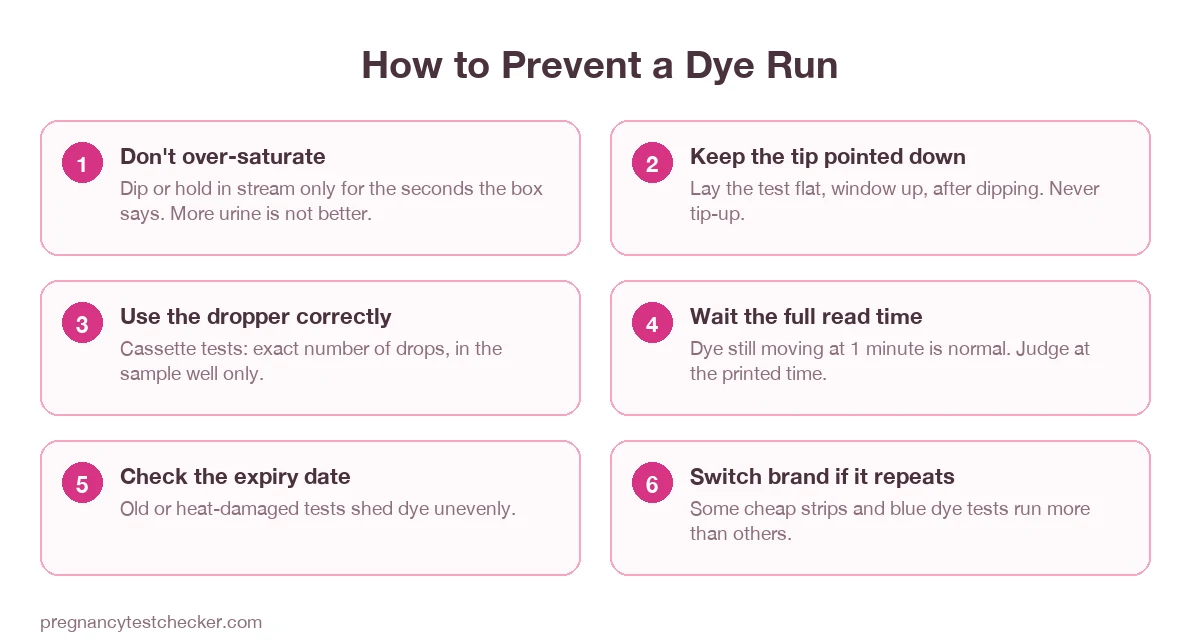
- Follow the saturation time on the box. Typically 5 seconds in the stream or 5 to 20 seconds dipped, depending on the brand. Do not round up.
- Dip to the marked line only. Submerging past the MAX line on a strip test floods it.
- Lay the test flat, window up, on a dry surface right after sampling.
- Use a clean, dry cup if you collect urine. Water left in the cup dilutes the sample and changes how dye flows.
- Wait for the timer. The pink wave at one minute is normal. The result at the read time is what counts.
- Store tests cool and dry and check the expiry date before use.
- Prefer pink dye tests if you have had trouble reading blue dye ones.
Frequently Asked Questions: Dye Run Pregnancy Test
Is a dye run a positive pregnancy test?
No. A dye run is excess dye smearing across the result window, not a reaction to hCG. A positive is a crisp, straight, vertical line at the T position, the same width as the control line. If the window clears within the read time and a clean line remains, that line counts. If only a smear remains, the test is invalid.
What does a dye run look like on a pregnancy test?
A pink or blue wash, smear, streak, or blotch in the result window instead of a clean line. It can cover the whole window, trail to one side, or sit near the T position with ragged edges. It usually appears in the first minute or two and often clears before the read time.
Why does the dye run on a pregnancy test?
Too much urine, reading too early while dye is still moving, holding the test tip-up, an expired or heat-damaged test, or a lower-quality strip. Blue dye tests are often reported to run more than pink dye tests.
How long does it take for a dye run to clear?
On a properly working test, the dye wave crosses the window in the first 30 to 90 seconds and clears by the read time, usually 3 to 5 minutes. If the window is still smeared at the printed read time, the test has not cleared and should be treated as invalid.
Is my test invalid if there is a dye run?
Only if the smear is still there at the read time, the control line is missing or blurred, or the window is too flooded to see distinct lines. A brief wash in the first minute that clears on its own is normal, and the result that remains is valid.
Dye run vs faint positive: how can I tell?
Look at shape and position. A faint positive is a thin, crisp, vertical line exactly at the T mark, the same width as the control line, that stays after the window clears. A dye run is irregular: blotchy, angled, trailing, or spread beyond the T position. If unsure, retest in 48 hours with first-morning urine.
What is the difference between a dye run and an evap line?
A dye run has color and appears early, while the sample is still moving. An evaporation line is colorless or gray and appears late, after the read window, as the strip dries. Neither is a positive result.
Can a dye run hide a real positive?
Yes. If the window is flooded, a genuine faint line can be impossible to see. That is another reason not to try to read through a smear. Retest with the correct amount of urine and you will get a clean window to judge.
Let AI Check Your Pregnancy Test
Just take a photo and get result
Bottom Line: Dye Run on a Pregnancy Test
A dye run is dye, not hormone. A brief pink wash in the first minute is normal and will clear. A smear that is still in the window at the read time makes the test invalid, and a blotch that is not a crisp, straight line at the T mark is not a positive.
Retest with the exact amount of urine the box calls for, lay the test flat, and read it only when the timer goes off. If the retest shows a clean line, trust it. If you are still unsure, a blood test from your provider settles it.
And if you would rather not debate smears versus lines, take a photo and let the Pregnancy Test Checker AI read it for you.